Connecting individuals and families with mental health resources, development, and community in the Antelope Valley and beyond.


Providing Responsive Care for Children with Complex Support Needs
An entry-level resource for caregivers and providers created by
Kraichelle Porter, George Santos-Garcia, Suzanne Tripoli, Gabriela Espinoza, and Monica Olsen
in partial fulfillment of the requirements for the DMH + UCLA Early Childhood Fellowship.
Jump to Caregiver Resources
Jump to Provider Resources
For Caregivers
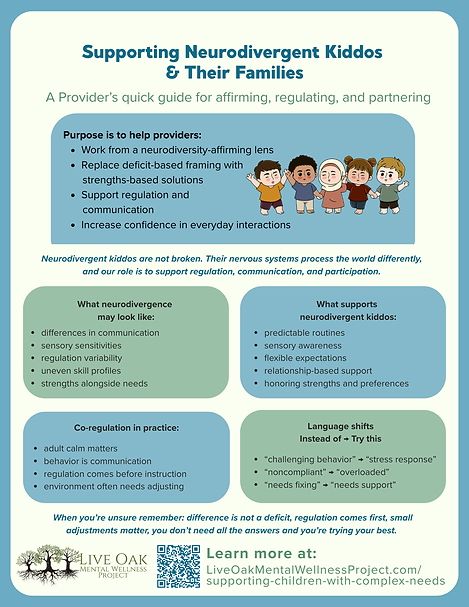
Quick Guide


Digging Deeper
Understanding Early Childhood and Neurodivergence
Young children grow and learn in many different ways. Some children follow a more expected developmental path for their age, while others develop differently because of how their brains and bodies process the world. This is sometimes called neurodivergence. A neurodivergent child might communicate differently, react strongly to sounds or textures, need extra help with transitions, or show a mix of strong skills in some areas and more difficulty in others. These differences do not mean a child is broken. They mean the child may need support that better fits how they learn, connect, and feel safe in the world.
It can be helpful to think of behavior as a message. When a young child cries, shuts down, has a meltdown, repeats the same thing, avoids an activity, or seems easily upset, that often means something feels too hard, too fast, too loud, too confusing, or too overwhelming. It is not a sign that the child is being difficult. Many children do better when adults slow down, use simple words, keep routines predictable, and pay attention to what helps the child feel calm and understood. Children usually learn best when they feel safe first.
Children are also affected by what is happening around them. Stress, trauma, prenatal exposure, medical needs, changes at home, or big demands from the environment can all affect how a child behaves, learns, and relates to others. Sometimes what looks like defiance is really stress. Sometimes what looks like a delay needs a closer look. Caregivers deserve clear explanations that do not blame them or shame their child. The goal is not to force a child to be like everyone else. The goal is to understand the child better and support them in ways that help them grow, participate, and feel secure.
One of the most important things a child needs is a steady adult. You do not have to be perfect. You do not need to have every answer. What helps most is staying curious, noticing when your child is overwhelmed, and responding with calm support instead of pressure. Small changes, like lowering your voice, giving fewer directions at once, or pausing before reacting, can make a big difference. Progress may look different for every child, but comfort, trust, communication, and connection are all meaningful signs of growth.
Supporting Your Child with Medically Complex Needs
You Are Not Alone in This
Caring for a child with complex medical needs can feel overwhelming. There may be a lot of appointments, information, decisions, and emotions happening all at once. Some days may feel manageable, while others may feel heavy, uncertain, or just plain exhausting. If you feel tired, stretched thin, or unsure at times, you are not doing anything wrong. You are carrying a lot. And even if it doesn’t always feel like it, you are not alone in this experience. Many parents and caregivers are walking a similar path, even if their stories look a little different from yours.
What “Medical Complexity” Means
You may hear providers use the term “medical complexity.” This usually means your child:
-
Has ongoing health needs that may affect different parts of their body
-
May need extra support with daily activities
-
May use medical equipment or need specialized care
-
May see multiple doctors or providers
Every child is different. Some needs are easy to see, and some are not. Some days may feel stable, and other days may feel harder. Things may change over time, and that can feel confusing or even discouraging. That does not mean you are doing anything wrong.
Your Child Is More Than Their Medical Needs
Your child is not just their diagnosis. They are still learning, growing, feeling, connecting, and becoming who they are. They have preferences, personality, joy, frustration, and ways of communicating that are uniquely theirs. Sometimes medical experiences can make things harder, like:
-
Transitions or changes in routine
-
Being in new environments
-
Handling noise, touch, or busy spaces
-
Managing big feelings
If your child struggles in these moments, it does not mean they are being difficult. It often means they are overwhelmed, uncomfortable, or trying to cope the best they can. Your child is doing the best they can with what their body and brain are experiencing.
What This Experience Can Feel Like for You
Caring for a child with complex medical needs is not just physical. It is emotional, mental, and constant. Many caregivers describe:
-
Feeling like they always have to be “on” or paying close attention
-
Juggling appointments, phone calls, and information
-
Getting different answers from different providers
-
Feeling responsible for making the “right” decisions
-
Having less time for rest, work, or other relationships
There can also be feelings that are harder to talk about, like:
-
Fear about your child’s health or future
-
Grief for what you expected life to look like
-
Guilt, even when you are doing everything you can
-
Frustration with systems that feel confusing or slow
-
Loneliness, even when you are surrounded by people
All of these feelings are valid. You are allowed to feel more than one thing at the same time.
Supporting Siblings
When one child has complex medical needs, it often affects the whole family, including siblings. Siblings may not always say what they’re feeling, but they are noticing, adjusting, and making sense of things in their own way. They may experience:
-
Confusion about their sibling’s needs or care
-
Worry or fear, even if they don’t show it
-
Feeling left out or wanting more attention
-
Pride, protectiveness, or a strong bond with their sibling
-
Mixed emotions that can change from day to day
It is okay for siblings to feel more than one thing at once. There is no “right” way for them to respond.
A Gentle Reminder
You do not have to meet every need perfectly. You are already balancing a lot. What matters most is that your children feel:
-
Seen
-
Cared for
-
Included in the family
Even small moments of connection and honesty can have a lasting impact.
You Know Your Child Best
You spend the most time with your child. You notice the small changes, the patterns, the signals, and the things that help or make things harder. That knowledge matters. Even if you do not use medical language, what you see and feel is important. You are not “just a parent” in this process. You are a key part of your child’s care team.
Working with Your Providers
You deserve care that feels respectful, clear, and supportive. Good providers will want to work with you, not just give instructions to you. It is okay to:
-
Ask questions, even more than once
-
Ask someone to explain things in a simpler way
-
Say when something does not feel doable right now
-
Share what is working and what is not
-
Take time before making decisions
If something feels overwhelming, you can say:
-
“Can we slow this down?”
-
“What is the most important thing to focus on first?”
-
"Can you help me understand this step by step?”
You do not have to absorb everything at once.
Managing All the Moving Pieces
It can feel like you are the one holding everything together: appointments, medications, therapies, insurance, school, and daily life. If it feels like too much sometimes, that makes sense. Some small things that may help:
-
Writing down questions before appointments
-
Keeping a notebook or notes app for important information
-
Asking providers to summarize next steps before you leave
-
Focusing on one or two priorities at a time instead of everything at once
You are allowed to take this one step at a time.
Advocating for Your Child
There may be times when you need to speak up for your child. This can feel hard, especially if you are tired or unsure. Advocacy can look like:
-
Asking for clarification when something does not make sense
-
Letting providers know when something is not working at home
-
Requesting support, services, or accommodations
-
Trusting your instincts when something feels off
You do not have to do this perfectly. You just have to keep showing up and asking questions. That is enough.
When You Feel Tired or Overwhelmed
Over time, caregiving can take a toll on your body and mind. You might notice:
-
Feeling tired even after rest
-
Being more irritable or emotional
-
Trouble focusing or making decisions
-
Feeling like you are running on empty
This does not mean you are not strong. It means you have been strong for a long time.
If you can, try to:
-
Take small breaks when possible
-
Let someone help, even in small ways
-
Say out loud when you are struggling
-
Lower expectations on hard days
You deserve care too.
Taking Care of Yourself (Even in Small Ways)
Self-care does not have to be big or perfect. Sometimes it looks like:
-
Sitting down for a few quiet minutes
-
Drinking water or eating regularly
-
Stepping outside for fresh air
-
Talking to someone you trust
-
Letting yourself rest without guilt
Even small moments of care can help your body reset. You are not selfish for needing this. You are human.
In the Moment: When Things Feel Like Too Much
There will be moments when everything feels overwhelming. For you, your child, or both. In those moments, it can help to:
-
Pause, even for a few seconds
-
Take a slow breath in and out
-
Sit down or change positions
-
Use fewer words
-
Give yourself time before responding
You do not have to solve everything in that moment. Sometimes the goal is just to get through it safely and gently.
A Few Reminders to Hold Onto
-
You are doing more than most people can see
-
Your effort matters, even when results are not immediate
-
You do not have to do this perfectly
-
It is okay to ask for help
-
Small steps are still progress
-
You are learning as you go, and that is enough
If You’re Not Sure Where to Start
You can always say:
-
“I’m feeling overwhelmed. Can we slow this down?”
-
“What should I focus on first?”
-
“Can you explain this in a simpler way?”
-
“I need a moment to think.”
You are allowed to take your time.
Remember...
There is no perfect way to do this. There is only your way. A way that is shaped by
your child, your love for them, and everything you are learning along the way.
Even on the hardest days, the care you are giving your child matters. It is seen. It
is meaningful. And it is enough.
For Providers
Understanding Early Childhood and Neurodivergence
In early childhood work, it is important to understand the difference between developmental variation, neurodivergence, and developmental delay. These are not all the same thing, and they should not be treated the same way. Some children develop differently without that difference meaning something is “wrong.” A neurodivergent child may show differences in communication, sensory processing, emotional regulation, attention, flexibility, or learning style. The clinical task is not just to identify what stands out. It is to understand what the child may be communicating through their behavior, how the environment is affecting them, and what kinds of support will help them participate more fully and comfortably in daily life.
A neurodiversity-affirming approach starts with the idea that difference is not the same as deficit. This changes both language and practice. Instead of describing a child as noncompliant, oppositional, or needing to be fixed, providers can think in terms of overload, stress, communication differences, and support needs. This shift matters because the way providers talk about development shapes how families understand their child and whether they feel blamed or supported. Clear, respectful language helps families stay engaged and helps providers focus on regulation, connection, and participation rather than compliance alone.
This work also requires a broad lens. Neurodevelopment does not happen apart from context. Trauma, prenatal exposure, medical conditions, cultural factors, systemic inequities, and family stress can all shape how a child presents. A child’s behavior may reflect a combination of neurodevelopmental differences, sensory stress, disrupted attachment, caregiver burden, or medical complexity. That means providers need to resist overly simple interpretations and instead respond with curiosity, humility, and practical support. Families often need information broken into manageable pieces, help making sense of what they are seeing, and next steps that feel realistic rather than overwhelming.
Co-regulation is the process of one person using their calm nervous system to help one another be able to calm and regulate their own nervous system through supportive interactions. Co-regulation is central to working with young children and their families. Young children often rely on adults to help them feel safe enough to settle, connect, and learn. Provider tone, pacing, body language, and emotional steadiness all affect how much information a family or child can take in. Before problem-solving, families often need regulation and connection. A calm provider helps reduce stress, improves communication, and makes collaboration more possible. In that sense, the provider’s presence is not separate from the intervention. It is part of the intervention.
The larger goal is to help families understand their child without pathologizing them. Good early childhood practice is not only about screening, diagnosing, educating, or referring out. It is also about translating complex developmental ideas into clear, compassionate language. Families should leave feeling more informed, more respected, and more confident in how to support their child. That is often where the most meaningful change begins.
Supporting Families of Medically Complex Children through a Trauma-Informed Lens
Notes for Providers: Staying Steady in Complexity
Why This Matters
Children with medical complexity and their families often live at the intersection of health care, development, and daily survival. Their lives are shaped not only by diagnoses but by ongoing coordination of care, emotional strain, and the constant navigation of multiple, often fragmented, systems. What may appear as “medical care” from the outside is, for many families, a continuous, immersive experience that impacts every part of daily life, including sleep, routines, relationships, employment, and emotional well-being.
Providers do not need to know everything. They need to stay steady, curious, and connected. This guide is designed to support providers in recognizing medical complexity, partnering with caregivers as experts, and reducing overwhelm through relational, trauma-informed, and developmentally grounded practice. At its core, this work is not just about supporting a child’s health needs. It is about supporting a family’s ability to sustain care, maintain connection, and continue functioning in the face of ongoing uncertainty.
Understanding Medical Complexity
Medical complexity is not defined by a single diagnosis, condition, or piece of equipment. Instead, it reflects the dynamic interaction between medical needs, developmental processes, caregiving demands, and systems of care. Children with medical complexity often experience one or more of the following:
-
Chronic or multi-system medical conditions
-
Functional limitations that impact daily living and participation
-
Dependence on medical technology or specialized care
-
Frequent involvement with multiple healthcare, therapeutic, and social service systems
It is important to understand that medical complexity exists on a spectrum.
Some children may have highly visible medical needs, while others may have conditions that are less apparent but equally impactful. Needs may fluctuate over time, intensifying during periods of illness or transition and stabilizing at other times.
A developmental lens is essential. Medical complexity does not occur in isolation from development. It interacts with a child’s ability to regulate emotions, engage in relationships, process sensory input, and tolerate transitions. Repeated medical experiences, including hospitalizations, procedures, and disruptions to routine, can shape a child’s nervous system and stress responses over time.
From a trauma-informed perspective, these experiences may influence:
-
Emotional regulation and reactivity
-
Tolerance for new environments or transitions
-
Social engagement and communication
-
Sensory sensitivity or avoidance
What may be interpreted as noncompliance, resistance, or challenging behavior is often an adaptive response to stress, pain, unpredictability, or sensory overload. Understanding this distinction is critical. It shifts the provider response from correction to curiosity, and from control to support.
What This Often Means for Families
Families are not just managing care. They are living inside it. Caregivers of medically complex children often carry a level of responsibility that is both constant and high-stakes. Their role extends far beyond traditional caregiving and frequently includes medical tasks, decision-making under uncertainty, and ongoing coordination across systems. Families may be navigating:
-
Chronic uncertainty related to their child’s health and future
-
Frequent medical appointments and competing provider recommendations
-
Disruptions to routines, sleep, employment, and family rhythms
-
Medical care occurring within the home environment
-
Ongoing vigilance and monitoring of symptoms or changes
-
Emotional strain related to fear, grief, and long-term stress
In addition, many families are simultaneously navigating multiple systems, including healthcare, insurance, early intervention, educational supports, and community resources. Each system may have its own requirements, timelines, and expectations, which are not always aligned. Over time, this level of demand
can lead to cumulative stress and fatigue.
Missed appointments, difficulty following through with recommendations, or emotional reactivity are often signs of overload, not disengagement. These responses reflect the reality of sustained strain rather than a lack of care or commitment.
It is also important to recognize that families do not experience medical complexity in isolation from their broader context. Factors such as race, culture, language, socioeconomic status, and prior experiences with systems can significantly shape how families access care, experience support, and engage with providers.
Partnering with Caregivers
Caregivers are experts on their child. Their expertise is built through daily caregiving, lived experience, and repeated interactions with complex systems over time. They hold nuanced knowledge about their child’s cues, needs, triggers, and strengths that cannot be fully captured in medical records or assessments.
Family-centered care requires a shift in perspective. Rather than positioning providers as primary decision-makers, this approach recognizes caregivers as essential partners in assessment, planning, and intervention. This is not about reducing professional expertise, but about integrating it with caregiver
knowledge in a way that strengthens outcomes.
In practice, this looks like:
-
Asking before telling, and seeking to understand before offering guidance
-
Offering options rather than directives, allowing for shared decision-making
-
Explaining the “why” behind recommendations in accessible and transparent ways
-
Checking for understanding, readiness, and capacity
-
Collaborating on goals that are realistic, meaningful, and aligned with family priorities
Caregivers may need time, flexibility, or adaptation of recommendations. This does not indicate resistance. It reflects the reality of managing complex care within the context of daily life, competing demands, and limited capacity. Goal-setting should be grounded in what is sustainable. Traditional care plans may unintentionally overwhelm families by focusing on ideal outcomes rather than feasible steps. Meaningful progress may include increased stability, reduced stress, improved caregiver confidence, or small shifts in routine. These outcomes matter.
From a trauma-informed lens, it is also important to recognize that many caregivers have experienced medical trauma, dismissal, or invalidation within systems. Trust is built over time through consistency, transparency, and respect.
Helping Families Navigate Complex Systems
Families of medically complex children are often functioning as unpaid care coordinators. They are responsible for managing communication across multiple providers, scheduling appointments, understanding treatment plans, navigating insurance requirements, and advocating for their child’s needs across systems. This level of coordination is complex and often overwhelming. Fragmentation of care can lead to:
-
Conflicting recommendations from providers
-
Gaps in communication between systems
-
Increased caregiver burden
-
Missed appointments or delays in care
-
Emotional distress and frustration
Providers may not be able to change the structure of these systems, but they can reduce the burden families experience within them. Supportive practices include:
-
Clarifying roles so caregivers understand who is responsible for what
-
Breaking information into manageable, prioritized pieces
-
Summarizing plans and next steps clearly
-
Reinforcing consistency across interactions when possible
-
Supporting caregivers in preparing for appointments or decision-making
-
Helping families identify what feels most urgent or achievable
Even small moments of clarity can significantly reduce stress. Supporting navigation is not about taking over. It is about partnering in a way that increases understanding, reduces confusion, and supports follow-through.
Recognizing Caregiver Fatigue
Caregiver fatigue is a natural and expected response to sustained caregiving under conditions of stress and uncertainty. It is not a failure of resilience or commitment. Caregivers of medically complex children often experience:
-
Chronic sleep disruption
-
Ongoing emotional strain
-
High levels of responsibility and vigilance
-
Limited opportunities for rest or recovery
-
Accumulated stress from repeated system interactions
Signs of fatigue and overload may include:
-
Irritability, emotional reactivity, or withdrawal
-
Difficulty making decisions or processing information
-
Missed appointments or inconsistent follow-through
-
Reduced engagement during interactions
-
Expressions of hopelessness, frustration, or exhaustion
Caregivers may also minimize their own needs due to guilt, fear of judgment, or past experiences of not being taken seriously. It is essential that providers recognize these signs as indicators of stress, not disinterest.
How Providers Can Respond
Before moving into problem-solving, focus on connection and regulation. When caregivers are overwhelmed, their capacity to process information, make decisions, and engage in next steps is reduced. Supporting emotional regulation creates the conditions for effective collaboration.
Supportive provider responses include:
-
Slowing pace and tone to reduce intensity
-
Using fewer words and avoiding information overload
-
Allowing pauses and space for processing
-
Naming stress or difficulty before offering solutions
-
Checking in about emotional readiness
-
Prioritizing one small, manageable next step
This approach is not about lowering expectations. It is about aligning support with capacity in the moment. Providers’ own regulation matters. A steady, calm presence can help reduce stress and create a sense of safety. This is a clinical skill, not just a personal trait.
Co-Regulation in Practice
When families are navigating medical complexity, stress is often high for both caregivers and children. Co-regulation refers to the ways providers use their own presence, tone, pacing, and responsiveness to support others in feeling more settled and regulated.
Before information can be processed or decisions can be made, nervous systems need support. In practice, co-regulation looks like:
-
Slowing your pace and tone
-
Using fewer, more intentional words
-
Allowing silence and pauses
-
Sitting at eye level when possible
-
Noticing and naming emotional states
-
Staying present without rushing to fix or resolve
Caregivers and children who are overwhelmed may appear disengaged, resistant, or reactive. These responses reflect stress, not lack of motivation. Supporting co-regulation does not mean removing stress or fixing emotions. It means helping families feel steady enough to continue engaging, even in the presence of ongoing challenges.
Helpful Language in the Moment
When you feel unsure or stuck, language that centers validation and partnership can help create connection:
-
“You’re doing so much to keep your child safe and supported. That matters, even when it doesn’t feel visible.”
-
“You’re carrying a lot. Before we talk about next steps, what feels hardest right now?"
-
“Would it help if I paused and summarized where we are before we move on?”
-
“There’s a lot happening around your child’s care. Where would you like us to start today?"
These statements acknowledge effort, reduce pressure, and invite collaboration.
When You’re Unsure, Remember
-
You do not have to fix everything.
-
Your steadiness reduces overwhelm.
-
Clarity, even in small amounts, is powerful.
-
Partnership builds trust over time.
-
Presence matters more than perfection.
References
American Academy of Pediatrics. (2023). Caring for Children and Youth With Special Health Care Needs.
Paley, B., & Hajal, N. (2022). Conceptualizing Emotion Regulation and Coregulation as Family-Level Phenomena.
Frontiers in Psychology. (2022). Trauma-Informed Approaches to Supporting Caregivers of Children With Complex Needs.
Frontiers in Education. (2023). Culturally Responsive and Trauma-Informed Care Across Systems.
Quick Guide